Performance Evaluation Process
Most companies have some form of Performance Evaluation Process, and Gradient is no different! However, Gradient has created a process that is thoughtful, intentional, streamlined, and hopefully without the “corporate” feel of other companies’ processes.
The ethos behind the creation of Gradient’s evaluation process is two-fold:
We heard that the team wants to feel more supported throughout the year and have more transparency into how they are performing. We developed two new processes to address this:
- Performance Evaluation Process that provides specific benchmarks against which employees can track their performance
- Goal Setting Exercise to help employees achieve their professional goals and ensure Gradient appropriately resources the endeavor
The performance review process combines the subjective nature of your manager with a transparent rubric of job performance dimensions and peer feedback.
First, let’s go over the actual steps in the performance evaluation process:
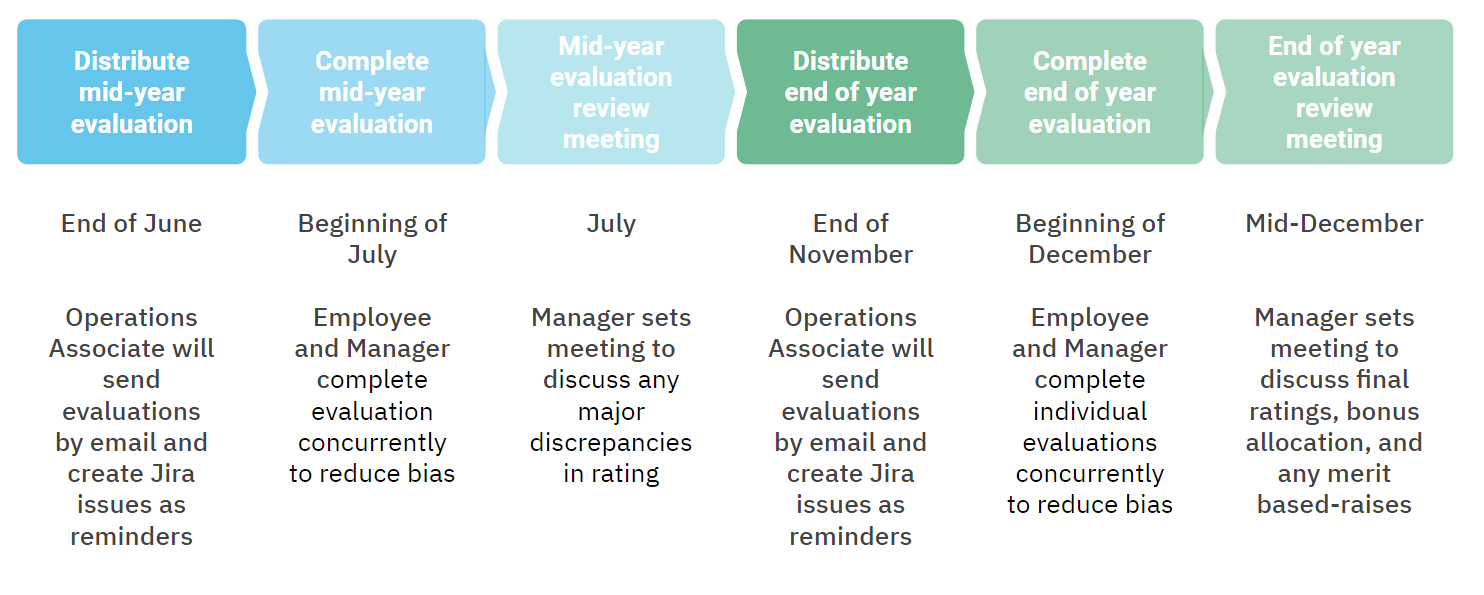
- Distribute mid-year performance evaluation.
- Every employee will complete a self evaluation, and their manager will fill out the manager evaluation concurrently to avoid bias.
- Manager sets meetings to discuss any major discrepancies in rating, coach employees on how to make any performance changes needed before the final evaluation at the end of the year, and the manager can support them in those changes.
- Distribute end-of-year performance evaluation.
- Every employee will complete a self evaluation, and their manager will fill out the manager evaluation concurrently to avoid bias.
- Manager sets a meeting to discuss final ratings, bonus allocation (if there is one to be allocated), and any merit based-raise eligibility.
The employee and manager will fill out the evaluation concurrently, followed by a mid-year evaluation review meeting. This will repeat at the end of the year, around the end of November. This end-of-year evaluation (not the mid-year) will be taken into consideration when determining bonus allocation. This process can also help you begin to discuss possible goals for the next year.
The dimensions for the evaluation rubric were specifically selected to support our Principles and are tailored to be applicable to each Gradient employee based on their team (Research, Product, or Internal). Each dimension of the rubric is weighted to reflect its importance in contributing to the success of the company.
For a more detailed description of the dimensions, rubric, and ratings, please refer to the Evaluation Dimensions & Rubric page.
Each rubric is intended to clarify the expectations for performance and levels of experience across the team. This rubric will be used to: 1) provide a benchmark for performance evaluations and 2) set objective expectations to guide career development.
Generally speaking, the skills expectations for each level are:
- Associate: Requires heavy editing and revisions
- Manager: Manager: Consistently produces client-ready (internal or external) work with limited revisions
- Senior Manager: Senior Manager: Has independent intuition for excellent quality work

The 1-7 ratings scale is designed so that for each domain, a team member can be rated against the three levels (Associate, Manager, Senior) with space to indicate being below (Rating 1) or above (Rating 7) expectations for each role level.
Employees and managers will complete their respective evaluations in the form of a Forsta survey. At the appropriate time, the Operations team will create a Jira issue for you containing the link to the survey and information on when it should be completed.
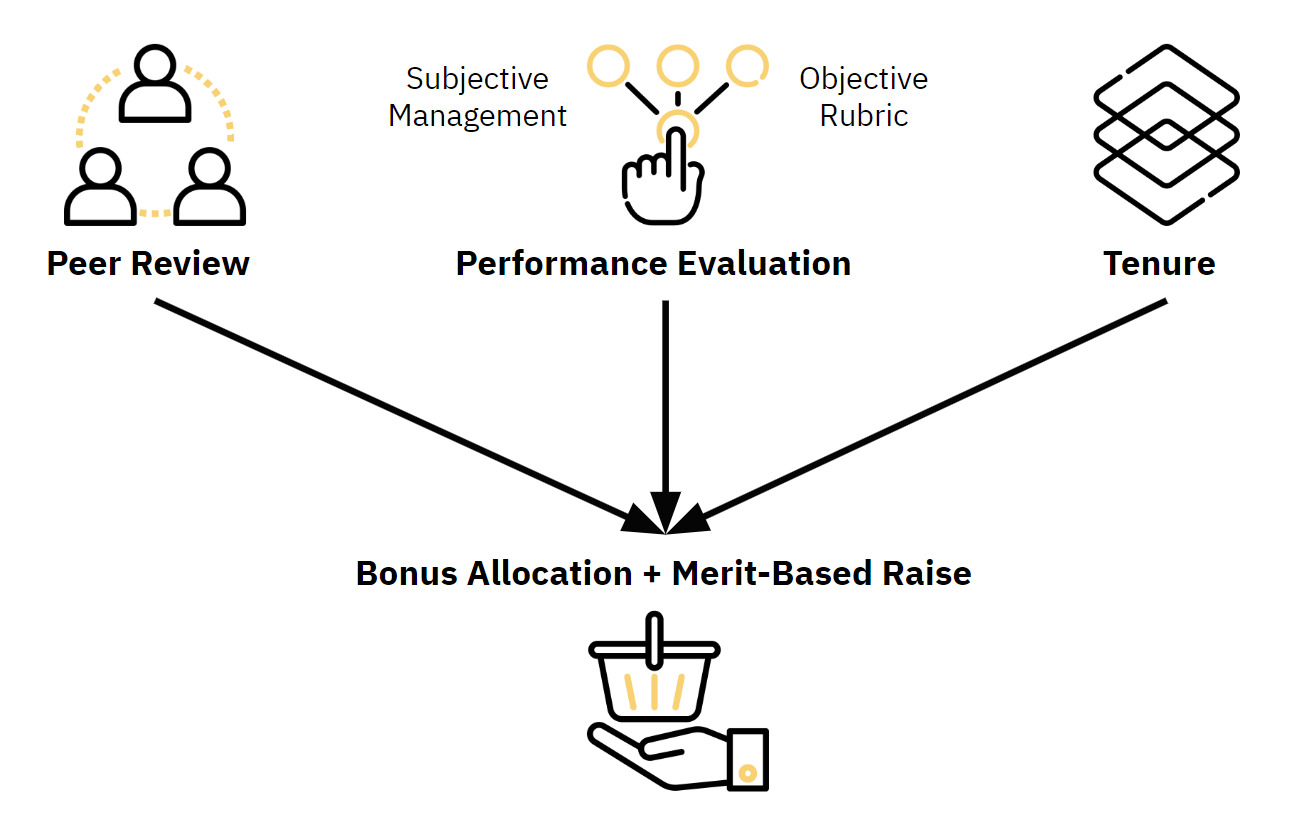
The performance evaluation is part of a 3-pronged process to determine bonus allocation and merit-based ranges eligibility, as well as provide continuous supportive feedback. The prongs are quarterly peer reviews, bi-yearly performance evaluation, and tenure with the company.
Individual Bonus formula:
- Peer Review Score (45%)
- Performance Review Rubric (25%)
- Tenure (30%)
The values in the below templated example table indicate the difference in employees’ scores for each component of the bonus allocation relative to the firm-wide average score of each component. This will help you benchmark your performance across the available dimensions.

Please see the Compensation page for information on merit-based raises.
Q. Is the annual performance evaluation process required?
A. Yes. The evaluation process is designed to give employees a regular opportunity over the course of a year to benchmark their performance and help Gradient by revealing where the company can better coach, nurture, and cultivate the skills that its team members need. Also, we want to have a transparent rubric and process for how bonuses are determined. We want to incentivize you to share in the company wealth with a transparent path.
Q. What if I disagree with the outcome?
A. Address your concerns by having a discussion with your manager during your Evaluation Review Meeting.
Q. I feel like part of my job was not captured in the rubric?
A. We definitely want to capture all dimensions that apply to all Gradient employees! Feedback is encouraged, so please reach out to leadership with any recommendations for revisions of the Rubric.
Q. What if I have multiple managers?
A. Your manager(s) will be assigned to you when you first start with Gradient Metrics. If you have multiple managers, your managers will both fill out the evaluation independently and then average the two.