Stage - Lead
Definition A Lead is an individual or organization that has shown interest in Gradient Metric’s products and services, but is not yet qualified to buy. The Lead Stage is the initial phase in the sales process where potential customers (Leads) are identified.
These are individuals or businesses that should ideally mirror our ICP attributes. Leads can come from our website, conference, network, demand gen efforts, or simply be a target list of accounts we feel could be potential customers. Note not all leads are viable customers. This stage should be used as the primary contact point for engagement in your sales process.
The get/who/to/by statement outlines the big picture needs for each of our ICPs and how a Gradient partnership is poised to solve those needs. Like the similarities and distinctions among the ICPs defined above, the desired response of our clients and our value proposition (the to and by, respectively) is the same for each ICP, but their organizations and specific problems (the who) differ.
The framework for these statements is: Our goal is to get target consumers who have a specific problem to achieve a desired response by emphasizing one message or action. Below are the get/who/to/by statements for the different types (or “buckets”) of Gradient clients. When conducting a discovery or sales call with a prospective client you should always consider a prospect’s general need (the who) and keep Gradient’s motivation and value proposition in mind (the to and the by, respectively).
- Household brands: Gradient wants to get household brands who are not confident answering high-risk strategic questions to enter an ongoing partnership with Gradient by providing them with actionable insights based on statistical rigor.
- **Brand strategy agencies: ** Gradient wants to get brand strategy agencies who are not confident answering their clients’ high-risk strategic questions to enter an ongoing partnership with Gradient by providing them with actionable insights based on statistical rigor.
- Philanthropies, think tanks, and political organizations: Gradient wants to get philanthropies and think tanks who have directional questions about their policies (and the general public’s response to those policies) to enter an ongoing partnership with Gradient by providing them with actionable insights based on statistical rigor.
The following matrix maps the decision-making journey our clients take before they arrive at Gradient’s door. It identifies the different stages at which our clients could decide they need us (a consultancy firm partnership).
Use the chart and information below to identify where a specific prospective client is in their journey and how to leverage one of Gradient’s offerings (or pillars) for that person at that point in the client journey. We will focus on how to approach clients at each phase of the “🤡 something’s messed up, needs a solution” client paradigm.
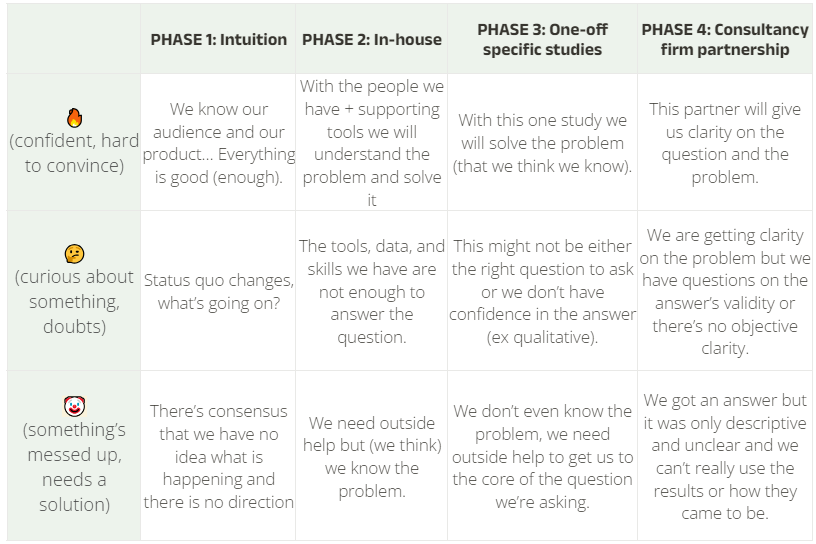
Once you’ve used the client journey map to identify where a potential lead is in their current process, we can control for some of these conversations by highlighting how we can solve the exact barrier to entry for the prospect. This will be especially important when the client is at any phase of the “🤡” paradigm and will be more receptive to outside help. The following talking points leverage our business pillars.
-
Clown Paradigm/Intuition Phase: Emphasize a consultative partnership. The client knows something is wrong, but not necessarily what–well, that’s our bread and butter! If the client partners with Gradient we will provide guidance at every stage of the research journey and work with the client to figure out what’s exactly what’s wrong. Not only that, but we’ll tell them how to fix it. We’ve guided many other organizations to objective clarity and won’t leave them hanging.
-
Clown Paradigm/In-house Phase: Emphasize our research methodologies are custom for each client, not off-the-shelf tools. The prospect’s intuition about their problem could be right, but we can use a sophisticated methodology and data to confirm their intuition. We will work backward from the prospect’s research question (or problem) to identify if that is, in fact, the accurate pain point; then we will go about solving for that pain point.
-
Clown Paradigm/One-off Specific Studies Phase: Similar to the intuition phase, we can emphasize our consultative partnership when the prospect is in this phase, but also how we’re equal parts data science and social science. With this blend we’ll be able to analyze potential problems without blinders and examine a client’s audience both qualitatively and quantitatively. This comprehensive approach will help us get to the core of the question the client is asking and their root problem.
-
Clown Paradigm/Consultancy Partnership Phase: If the prospect only has a data dump of descriptive statistics, then that’s definitely a job for Gradient! Emphasize how we work backward from a client’s specific question or problem to ensure the results give them directional insights. Tell them they’ll have a ghost deck as soon as we start their project so they can see how the data will be presented and what questions will be answered.